When we talk about Software-defined Networking (SDN), we see a lot of technologies and solutions going around, from virtual components to the physical world.
Vendors are making efforts to launch SDN solutions that will ensure business continuity bringing benefits to the end customer. In fact, many of these solutions have been launched despite the technology still being substandard. After all, we are at the hype stage!
Take a peanut M&M with you and taste this article about my point of view on the actual SDN flavours.
Technology is not the only key aspect that will contribute to the success of these types of solutions. Let’s consider it as the core of the entire SDN framework, like the peanut inside a real M&M’s chocolate candy.
But what do SDN and Peanut M&M’s have in common?
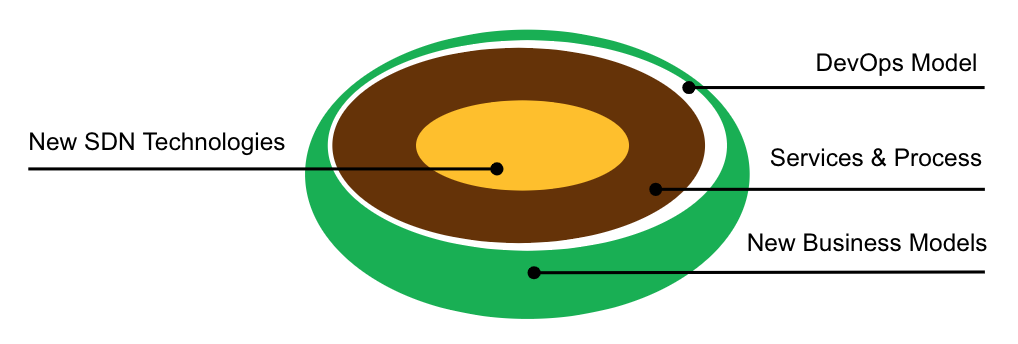
If we look at the cross-section of Peanuts M&M’s chocolate candy from the top-down, we see that is composed of four different layers. These four layers have different sizes, different colours and different tastes, corresponding to the different functions of each layer of the SDN framework.
As I mentioned before, the core is the layer where the SDN technologies, the set of functionalities and vendors’ strategies are placed in. They play an important role because they will support all the surrounding layers. Therefore, it is required some sort of market maturation regarding product sets and how SDN is technically achieved, like a peanut that must be crunchy.
 |
|---|
| Figure 1: The essential elements for paving the way to SDN success. |
Involving technology, the possibilities of developing new services and innovative processes through integrated and personalized modules are huge. I compare them to real milk chocolate that should be irresistible and it’s where the taste can make the difference.
Imagine providing prepackaged bundled solutions with default features, service-level agreements (SLAs) and security services that end customers can select from an online portal and activate them with a simple click. In the near future, it will be possible to engage customers in new ways, allowing them to add new network services, modify old ones and upgrade to a cloud service infrastructure.
This type of flexibility will allow end customer and network operating engineers to quickly create new services by using self-service platforms that automatically provision them in a couple of minutes. Moreover, imagine Service Providers (SPs) being able to respond to market opportunities and rapidly adapt to traffic pattern changes.
By making use of the SDN controller functionalities, SPs can apply policies dynamically to improve the end customer experience and might optimize bandwidth when needed. As a result, they will maximize revenues related to capturing new business models while effectively reducing operating costs.
The inner coating is related to a paradigm shift in software-defined networking to merge two different areas of knowledge resulting in the DevOps model.
Since the deployment of an application or a service impacts the entire lifecycle from business needs to software implementation and requirements, and quality assurance, many processes are implemented along the way. Consequently, these processes are divided into several activities and executed by different people and perhaps owned by different departments within the organization.
So, this model can be described as a set of processes, methods and systems for communication, collaboration and integration between Development teams and Network Operations. Maybe in the future, organizations will need people who have both programming skills and network knowledge (devices, architectures and protocols).
On the other hand, I see this area as a coaching process (people, knowledge and change) in which every manager will have to maintain certain levels of performance and be sure that people are following policies and procedures. It is possible that different people in the organization are at different levels of knowledge, gradual training can be planned to start with skills that are most critical to immediately support SDN technologies.
Finally, the M&M outer coating!
The colour is added to a finishing syrup and applied as the final coat. Each candy has a different colour, which enables the consumer to choose the colour he wants.
This is about business models and needs that lead to SDN adoption. Rather than help customers understand the real benefits of SDN, it is important to work together with them to develop more valuable business plans in order to increase revenue and decrease operational costs. The SDN business model and strategic plan must consider technology maturation, requirements, rollout plans, services and applications, changes in the organization and new ways to do business.
With the SDN you will be ready to create new experiences for your customers and get them to be passionate with the simplicity to consume new services.
Haven’t you tasted SDN yet?